Core assessment The cycle between gold, board strength, player health, and the team's future ceiling. Managing the economy is fundamentally a question of when to let each kind of asset bear the risk.
Key findings
Gold determines when a player can act; the shared pool determines whether that gold can buy the champions they need; items, Artifacts, and Emblems determine how efficiently those resources become combat strength. Economy decisions must account for time, probability, health, and the team's eventual ceiling together.
1. The early income ramp delays high-impact decisions until more information is available. It preserves trade-offs while limiting how far early mistakes can compound.
2. PvE rounds freeze win or loss streaks without awarding streak income. Players gain a planning window without continuing to earn performance-based income from risk-free fights.
3. The shared pool gives scouting, buying contested units, denying units, and pivoting clear economic value. At its core, competition is a contest over a limited chance of finding the units you need.
4. Item conversion efficiency must account for specific synergies. Artifacts are closer to tools that rewrite the rules of a build; average strength alone cannot capture the risk of extreme outcomes when paired with particular champions.
How resources become team strength
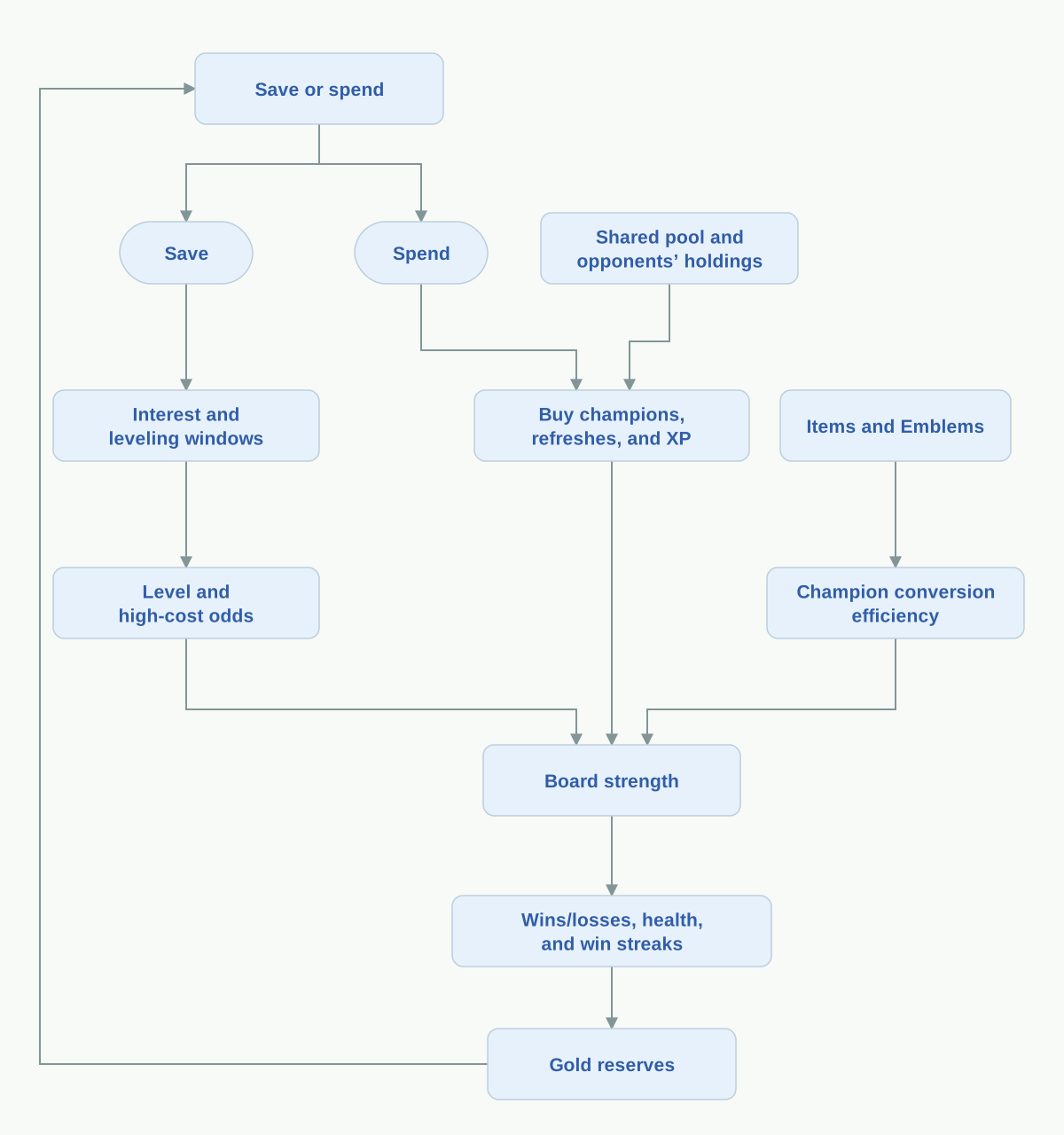
I. The core resource cycle and risk trade-offs
TFT can be understood through asset conversion: gold becomes immediate strength, team slots, and shop opportunities; health buys more time to save or earlier carousel priority; an established board can, in turn, generate win and win-streak income.
Resource cycle overview
Savings loop: gold reaches 10 / 20 / 30 / 40 / 50G → 1–5G interest per round → faster subsequent accumulation | ||||||
|---|---|---|---|---|---|---|
Gold reserves | → | Spending choices | → | Immediate strength + future ceiling | → | Combat results |
Win / win streak: +1G, streak income, and health preserved | ↖ ↗ | Loss / loss streak: streak income and earlier carousel priority, at the cost of health | ||||
Feedback into the next round: current gold + remaining health + team completion → reassess whether to save or spend ↺ | ||||||
Figure 1 | TFT's core resource cycle
1. Sources of gold income
Source | Values / rules | Trigger | Design purpose |
|---|---|---|---|
Base income | 1-2: 2G; 1-3: 2G; 1-4: 3G; 2-1: 4G; usually 5G per round from 2-2 onward. | Received automatically at round settlement; a steady, unconditional cash flow. | Establishes a minimum rate of economic growth so players who fall behind can still take part in later decisions. |
Interest income | Every full 10G held grants +1G at the next settlement; 10/20/30/40/50G yields +1/+2/+3/+4/+5G, capped at 50G. | Calculated from the amount of gold held at settlement. | Encourages saving and creates clear interest thresholds.Encourages decisions around win and loss streaks. |
Win reward | Winning a player combat grants an additional +1G. | Triggered only by a player-combat win; stacks with win-streak rewards. | Gives immediate combat strength a direct economic return.Encourages further leveling to maintain a win streak. |
Win / loss streak rewards | 3–4 consecutive rounds: +1G; 5 rounds: +2G; 6 or more rounds: +3G. | Consecutive wins or losses in the same direction; a change of result breaks the streak. See “Economy pacing and cash-out timing” for PvE settlement and pacing effects. | Encourages players to commit to a direction and weakens the alternating win-loss pattern. |
Monsters / loot orbs | Gold amounts vary; rewards may instead include champions, items, or other resources. | Defeat PvE units and collect loot; the drop pool varies by stage and patch. | Provides outside resources and variation between games, but is not a fixed cash flow that can be reliably planned around. |
Selling champions | One-star champions generally sell for their purchase cost; upgraded high-cost champions may sell at a discount. Exact selling rules depend on the patch. | Sell a champion from the bench or board. | Strictly speaking, this liquidates an asset rather than creates new gold. The player gives up the champion, its star level, and team-building options. |
Selling free champions | Champions granted free through the carousel, loot, or a mechanic become available gold when sold. | Acquire a champion at zero purchase cost, then sell it. | Increases available cash, but the decision to sell depends on the champion's item, trait, and transition value. |
Augments | Values vary: rewards may be direct gold, free refreshes, XP, champions, or delayed returns. | Triggered by selecting the relevant economy Augment. | Some provide cash; others provide combat strength that converts into income. Either uses an Augment choice. |
Economy traits / champions / items | Values and conditions vary by set: examples include loss-streak accumulation, drops on kills, round rewards, and cash-outs. | Activate a trait, equip a specific item, or meet a condition with a particular champion. | Usually costs board strength, health, or commitment to a path; these mechanics assign a price to risk. |
Portals / Encounters / set-specific shops | No single value applies. They may grant gold, sell resources, or change the economy for the entire game. | An opening selection, a stage event, or a special shop during planning. | Changes the game's economic conditions, requiring players to reassess the value of interest, refreshes, and leveling. |
Three income types from a design perspective
Predictable income: base income and interest. Players can calculate these in advance; they form the framework of an economy plan.
Performance-based income: wins and win/loss streaks. Tied to results and discipline in following a chosen path, these are returns on risk.
Random / conditional income: loot, Augments, traits, and set mechanics. These create variation and prompt changes of direction during play.
2. Gold expenditure breakdown
Expenditure | Cost per use | Return (short / long term) | Risk, opportunity cost, and sunk cost |
|---|---|---|---|
Buying champions | The champion's cost: 1–5G per copy | Short term: field a unit, activate a trait, or make a two-star. Long term: collect core units, pursue three-stars, or retain pivot options. | Ties up cash and bench space; falling below an interest threshold loses income. Individual copies can be sold back, but upgraded units may sell at a discount. Missed interest cannot be recovered. |
Buying experience | Usually 4G = 4 XP | Short term: level earlier, field another unit, and improve shop odds for high-cost champions. Long term: reach a higher team-size ceiling. | XP cannot be sold; the investment is irreversible. If leveling does not improve the board, the player may lose interest without preserving health. |
Refreshing the shop | Usually 2G per refresh | Short term: find pairs, key traits, or core champions. Long term: pursue two- or three-stars and complete the team. | A pure expense with no guaranteed hit, making it the clearest sunk cost. It also gives up the opportunity to level or preserve interest with that gold. |
Special purchases | Determined by the set mechanic; the price may be fixed or vary with resources / stage | Buy Augments, special units, items, XP, refreshes, or one-time effects. | Compare these mechanic-specific purchases with the alternative value of the regular shop or leveling; time limits add decision pressure. Augments themselves are usually chosen for free and should not all be described as “Hextech purchases.” |
Holding champions (implicit expenditure) | No additional listed price, but the gold already paid remains tied up | Retains pairs, alternative paths, and control over the shared pool. | Reduces liquidity. Keeping a unit that will not yet be fielded may drop the player below a 10G threshold. It is not an explicit purchase, but it carries a real opportunity cost. |
3. Key decision points: when to save and when to spend
Typical situation | Basis for the decision | Effect of interest thresholds | Underlying question |
|---|---|---|---|
Situation A | Stage 2: reach an interest threshold or protect a win streak | Spend when natural shops are strong, pairs are available, items can be completed immediately, or leveling adds a key unit. With an average board and no clear upgrade, prioritize reaching 10/20G. | 10G and 20G are particularly important. If keeping another 3G unit drops the balance from 10 to 9, the real cost includes not only 3G but also 1G of interest next round. | Choose between being stronger now and starting to compound income earlier. |
Situation B | Stabilize at level 6 on 3-2 or keep earning interest | Consider health, the lobby's overall strength, pairs on the board, whether one key unit is missing, and the distance to the next natural level-up. | Stopping at 30/40G after rolling can balance stability with interest. At low health, it may be right to spend through several thresholds. | Trade economy for midgame stability to avoid being forced to spend more later. |
Situation C | Roll deeply at level 8 on 4-2/4-5 or push for level 9 | Does the core four-cost need to be two-star? How many players contest it? Can the current frontline hold? Is there enough health to lose two more rounds? | Going from 50 to 30G loses 2G of interest per round, but is often worthwhile if a two-star carry saves 15–25 health and starts a win streak. | Balance current win probability against the final team's ceiling. |
Situation D | Slow-roll a low-cost team or go all in | Consider shop odds for the target cost at the current level, copies already held, pool competition, health, and stage. | Standard slow rolling keeps 50G at the target level and spends only the surplus. Near elimination, or when only 1–2 copies are missing, the balance can drop to 30/20/0. | Trade time for more expected attempts; health determines how long that remains possible. |
Situation E | Preserve a win or loss streak | On a win streak, ask whether spending meaningfully raises the chance of winning. On a loss streak, ask whether the board might win accidentally and how to lose less health. | A streak of 6+ wins or losses adds 3G. Breaking it loses more than that round's income: it also resets future accumulation. | Continuity along a chosen path is itself an asset that can be managed. |
How interest thresholds change behavior
29G and 30G differ by 1G in next-round income; 30G and 39G earn the same interest.
This makes 20G a stepping stone worth protecting. Likewise, 32G is a reasonable threshold because the balance can naturally recover to 50G.
A threshold's value depends on how long the player can keep saving. If elimination may come next round, the compounding value of 50G is far lower than the value of converting it into strength immediately.
Suggested decision order: risk of elimination → preserving or breaking streaks → whether spending creates a clear upgrade → only then, preserving interest at a multiple of ten.
4. Comparing economy paths: win streaks and loss streaks
Dimension | Win-streak play | Loss-streak play |
|---|---|---|
Goal | Convert immediate strength into win rewards, streak income, and high health; maintain control of the lobby's pace. | Trade health for loss-streak income, earlier interest thresholds, and carousel priority, then become substantially stronger on a key round. |
Main methods | Level actively; buy pairs / two-stars that can be fielded immediately; complete flexible items early; scout and adjust positioning every round. | Control board strength to lose while taking little damage; prioritize economic thresholds; plan the pivot round, items, and core champions ahead of time. |
Advantages | A larger health buffer; an earlier path to securing a top-four finish; opponents must follow the pace; more room to pursue levels and a higher ceiling late in the game. | The economy starts quickly; item choice is usually better; the cash-out round can produce a substantial jump in strength. |
Main risks | If the streak breaks despite early investment, both interest and streak income are lost. Maintaining the pace may force continued spending. | Health is a finite budget. An accidental win breaks the income stream; missing units or failing to complete the transition can lead directly to elimination. |
Core skills | Assess relative board strength, preserve wins at minimum cost, build flexible items, and replace transitional units as needed. | Control strength precisely, calculate how many losses are affordable, and complete rolling, board changes, and item transfers under time pressure. |
II. Economy pacing and cash-out timing
1. The early income ramp
Early base income rises from 2G, 2G, 3G, and 4G to a steady 5G. This both increases the density of early choices and limits how far mistakes compound: players cannot buy every shop and must judge pairs, entry points into traits, and economic thresholds. Yet levels are low, available actions are limited, and high-interest brackets have not been reached, so a single misjudgment is less likely to immediately become an unrecoverable economic gap.
Round | Base income | Information available to the player | Design purpose |
|---|---|---|---|
1-2 | 2G | The first champions and loot are still incomplete | Prevents buying out the shop without thought; mistakes remain small |
1-3 | 2G | Initial pairs and item-component directions emerge | Continues to demand trade-offs without opening up large-scale economy actions |
1-4 | 3G | The outline of a team becomes clearer | Introduces the conflict between keeping pairs and reaching an interest threshold |
2-1 | 4G | First player combat; opponents' strength becomes readable | Gives more economic agency once more information is available |
From 2-2 onward | 5G | Augments, items, and the pace of the game become clearer | Opens the full cycle of saving, leveling, and refreshing |
Design assessment:The income ramp does more than protect beginners: it delays high-impact economic decisions until the player has fuller information. The system also restricts high-cost champions in low-level shops, avoiding an involuntary penalty when a player sees a unit they cannot afford.
2. PvE rounds and streak settlement
The count here should be understood as a retained or frozen state: PvE is not a new win or loss, so it neither automatically adds to the streak nor breaks the established path. For this project, the report uses a rule that preserves the streak but pays no win- or loss-streak reward. Historical versions have implemented this differently; any practical application must specify the version.
Rule option | Effect on player decisions | System benefit | Potential issue |
|---|---|---|---|
Preserve the streak; pay no reward | PvE provides an economic buffer, but no extra performance income | Avoids subsidizing leaders or open-fort play through risk-free rounds | Creates a planned pause in streak income at the end of a stage |
Preserve the streak; pay the existing tier | An established path produces steady income across stages | Increases the value of deliberately managing a win or loss streak | Amplifies both ends of the economy and may intensify snowballing |
PvE advances the streak count | Players can enter a higher reward tier without risk | The rule appears more continuous | Automatic tier advancement weakens the risk basis of performance rewards |
Counterfactual assessment:If PvE also paid rewards, players with an existing win or loss streak would receive predictable, free compounding income at the stage's end. If PvE also increased the streak count, it would automatically carry them across reward thresholds. The former can be a tuning lever for strengthening economy paths; the latter more easily separates rewards from actual PvP risk.
3. Reaching 50G from different interest brackets
The table assumes no further spending and excludes wins, streaks, loot, and economy Augments. It counts only 5G base income per round and normal interest. The round count is the number of income settlements needed to reach at least 50G.
Starting gold | Accumulation path | Reaching at least 50G | Decision implication |
|---|---|---|---|
10G | 10→16→22→29→36→44→53 | 6 rounds | Starts earliest, but still needs a long safe window to reach maximum interest |
20G | 20→27→34→42→51 | 4 rounds | Leaves substantial room for compounding in the midgame |
30G | 30→38→46→55 | 3 rounds | Approaches the range where stabilization and economic recovery can coexist |
40G | 40→49→58 | 2 rounds | Falling below 40 immediately reduces the efficiency of the next settlement |
50G | Already reached | 0 rounds | The goal becomes preserving maximum interest while spending the surplus above 50G |
Design assessment:Multiples of ten give gold a time value. Players are really comparing whether the strength gained by spending can preserve a streak or health against the next round's lost interest and subsequent compounding.
4. When to convert the economy into strength
Round timings should be understood as branches in a resource path, not fixed answers. Under common economy logic, going all in after reaching level 8 on 4-1 or 4-2 and reaching level 9 around 5-1 are usually mutually exclusive. The former buys immediate survival; the latter requires keeping enough capital and health at level 8. Exact timing varies with XP requirements, Augments, loot, and set mechanics.
Path | Stage 4 position and actions | Position around 5-1 | Core value purchased |
|---|---|---|---|
All in to survive | Reach level 8, then roll down to 0–10G, prioritizing a two-star carry and main tank | Usually remains at level 8 and rebuilds the economy | Trades future ceiling for stability and survival |
Standard stabilization | Reach level 8, then roll down to 20–30G to find key two-stars | Continue rolling or prepare for level 9, depending on health | Balances immediate strength and interest |
Push for level 9 | Roll little or not at all at level 8; absorb pressure with the current board | Reach level 9 around 5-1 or 5-2, seeking five-cost utility and a higher ceiling | Uses health to buy a higher-level window |
Low-cost three-star pursuit | Stay at level 6 or 7 and slow-roll for three-stars in the target cost tier | Continue upgrading units; level 9 is usually not the goal | Trades team size and high-cost odds for a better chance of finding the target units |
III. The shared pool and Emblem competition
1. The nature of shared-pool competition
The shared pool turns other players' purchases into variables in your own odds. When one player takes a champion, others become less likely to find it in subsequent shops. Scouting, avoiding contested teams, rolling earlier, and pivoting during play therefore gain direct economic value. The contest is fundamentally over a finite share of probability.
Action | Strategic value | Cost paid | More suitable timing |
|---|---|---|---|
Scout competing players | Estimate remaining copies and when opponents will begin rolling | Planning time and attention | Before committing a large amount of gold to refreshes |
Buy contested units early | Secure scarce four-costs or key core champions first | May disrupt interest and leveling timing | When the target unit is a major upgrade and several players contest it |
Hold units to deny an opponent | Reduce the opponent's chance of finding a two- or three-star | Tie up gold and bench space, and give up options of your own | When the opponent's upgrade would affect placements and holding costs are low |
Pivot proactively | Leave a low-expectation pool and use uncontested champions | Gold already spent rolling, items, and the trait path may become sunk costs | When too many players contest the team and an alternative carry can use the existing items |
A rough way to assess holding units for denial:The reduction in the opponent's hit probability × the combat value of their upgrade × its relevance to your placement, minus the costs in gold, interest, bench space, and pivot opportunities. Denial is not free interaction: it is an investment against an opponent, paid for with your own liquidity.
2. How Emblems reshape the balance of traits and champions
An Emblem's central function is to rewrite a champion's native trait relationships. It lowers the team-slot cost of reaching a trait threshold and allows strong champions to replace units included only to fill the trait count. Emblems can therefore raise the ceiling of trait-driven teams or let champion-driven teams bypass native restrictions.
Affected area | Positive effect | Main risks | Balance points to watch |
|---|---|---|---|
Trait-driven teams | Reach high thresholds earlier and replace weak trait fillers | Higher trait tiers appear too early, substantially lowering the team's cost | How much earlier the threshold arrives, the number of weak slots, and the difficulty of obtaining the Emblem |
Champion-driven teams | Give a carry or main tank with high conversion efficiency access to new stats and rules | The strongest individual champion gains another multiplier, exceeding its native balance budget | Whether there is only one viable holder, and whether both ability and trait amplify the result |
The wider metagame | Adds pivots and nonstandard builds, increasing variation between games | Several traits may point to the same optimal holder, reducing diversity instead | Whether Emblems expand the candidate pool rather than create a single answer |
IV. Trait structure and champion roles
1. Basic trait structure: Set 11, Inkborn Fables
Scale / trait | Activation thresholds | Effect type | Power curve | Structural assessment |
|---|---|---|---|---|
Large | Storyweaver | 3 / 5 / 7 / 10 | Summon growth plus team-wide / trait-specific stats; choose upgrades for Kayle at key thresholds. The 10-unit tier is an extremely difficult chase ceiling. | A nonlinear staircase. 3 provides the basic summon; 5/7 gives Kayle a clearer combat role; 10 changes the rules at a fundamental level. Higher tiers require more dedicated slots and greater commitment to the team. | A typical large vertical trait: the trait itself is the team's centerpiece. |
Medium | Duelist | 2 / 4 / 6 / 8 | An attack-stacking combat bonus centered on attack speed and sustained damage; higher tiers usually add survivability / strength. | Relatively smooth, with clear jumps at 6/8. Lower tiers can be a small addition; middle and high tiers require several similar units and items built around attack-speed returns. | A typical class trait: gives champions with a shared damage pattern a common way to scale. |
Small | Lovers | 1 | A unique form / positioning trait: the front two rows use Rakan, the back two use Xayah; the other partner provides a supporting effect when the ability is cast. | Complete on activation, with no vertical stacking. Its strength comes from one five-cost unit's choice between frontline support and backline damage, rather than accumulating units. | A typical single-unit mechanic trait: a label explaining a legendary champion's unique rules. |
Design differences across the three examples
Large traits primarily give a team direction. Early units let players anticipate the final team, but also require commitment to that path.
Medium traits primarily create consistency in combat logic. Champions across cost tiers share a way to scale, while other teams can borrow the trait at a smaller threshold.
Small traits primarily distinguish individual units. Rather than demand more units, they give a high-cost champion an identity that changes positioning or team-building rules.
2. Champion cost and functional roles
Cost | Typical role | Ability characteristics | Role in the team |
|---|---|---|---|
1-cost | Early-game filler, a trait entry point, basic frontline / backline; a few can anchor low-cost reroll teams. | Clear targets and readable casting and effects; restrained numbers and mechanics emphasize quick understanding. | Provides an opening direction and inexpensive combinations; three-starring can extend its useful life. |
2-cost | Early-to-midgame backbone, transitional carry / main tank, low-cost three-star core, or utility piece. | Adds a condition or interaction beyond a one-cost and begins to express item and trait synergies. | Connects early and midgame; can either provide board quality or form a standalone reroll team. |
3-cost | Midgame core, a turning point for the team, or a major three-star win condition. | More complete mechanics, often including area control, ongoing growth, movement, or multiple benefits. | A two-star stabilizes the midgame; a three-star can be the final carry, but demands substantial rolling investment. |
4-cost | Standard late-game carry / main tank and team core. | Distinctive abilities and strong item conversion; reaching two stars often produces a clear qualitative upgrade. | Determines level 7/8 rolling windows and the completion of common teams; also the most contested shared resource. |
5-cost | Legendary unit, utility that breaks a stalemate, a higher team ceiling, or a way to close out fights. | Abilities often change rules, affect the whole board, offer multiple forms, or provide strong crowd control. One star offers unique utility; two stars raises the ceiling substantially. | More than simply bigger numbers: it gives a late-game team new ways to solve problems. |
3. Trait and champion interactions: common team structures
Structure | Building logic | Conditions for success | Typical form |
|---|---|---|---|
Trait-driven (vertical) | Choose a high trait threshold first, then add the carry, main tank, items, and Emblems around it. | Higher trait tiers offer a clear qualitative upgrade, and the dedicated units cover the necessary functions. | Storyweaver: Kayle and the higher thresholds together form the win condition. |
Champion-driven (core and supporting shell) | Choose a strong carry / main tank first, then use the fewest trait commitments needed to supply attack speed, Ability Power, durability, mana generation, and crowd control. | The core unit converts items efficiently, and the supporting team can change with the shops. | A four-cost carry + a 2/4 class trait + a flexible frontline. |
Dual-carry / combo-driven | Two or more champions complement one another: the frontline buys time, the carry deals damage, and the secondary carry handles particular targets or shares traits. | A single carry has a clear weakness; combining units makes the whole stronger than the sum of its parts. | Two carries sharing a trait, chained crowd control, or frontline-backline interactions. |
Star-level-driven (reroll) | Choose a 1–3-cost core based on natural shops and competition, slow-roll for three stars at the appropriate level, then add traits and high-cost units to raise the ceiling. | The three-star return compensates for fewer team slots and delayed leveling. | A low-cost three-star carry / main tank, followed by high-cost utility later. |
Flexible mixed-trait / high-cost quality | Prioritize the strongest available two-stars and flexible small traits, gradually replacing low-cost transitional units. | Units complement one another and lower trait tiers are efficient; demands flexible transitions and broadly usable items. | Several two-unit traits + four-/five-cost crowd control, a main tank, and a carry. |
Economy-trait pivot | Use a risk mechanic to accumulate resources in the early and midgame, then quickly sell / replace the relevant champions after cashing out and move into a standard high-cost team. | The economy trait cannot also be too strong in combat; the cash-out window must be clear and put pressure on execution. | Accumulate through losses → cash out → roll deeply → change the team. |
Recommended team-building order
Identify the win condition: is this game won through a high trait tier, low-cost three-stars, or a two-star four-cost?
Identify the core champions: who deals damage, who absorbs it, and who provides key control / support?
Use traits to meet the core's needs: prioritize giving every fielded unit a specific problem to solve, rather than simply maximizing trait counts.
Check the economic path: at which level are the target units more likely? Does the plan require slow rolling, a major roll-down at a stage breakpoint, or rapid leveling?
Plan late-game replacements: which low-cost units can be replaced by five-cost utility without breaking key traits?
Overall structure The economy determines when players can afford to change the team; the shop and cost tiers determine what they can find; traits determine why units should be fielded together; champion abilities determine how that team actually wins a fight. Together, these form TFT's complete strategic cycle. |
|---|
V. Item conversion efficiency and build interactions
Items are resources whose value is realized through ability structure, attack patterns, positioning, traits, and fight duration. The same item can add vastly different amounts of team strength on different champions. Item assignment is therefore an important part of TFT's team building, beyond simply raising star levels and filling trait counts.
1. Defining item conversion efficiency
Item conversion efficiency can be understood as the expected marginal strength an item adds to the current team by occupying one slot, minus the opportunity costs of passing over other holders, committing to a path, and making future transfers difficult. The object of evaluation should be the combination of champion, item, team, and game conditions, not the item or champion in isolation.
Concept | Meaning | Common misconception |
|---|---|---|
Item dependence | Without a specific item, the champion's startup speed, attack range, or survival loop does not work | High dependence does not necessarily mean the highest item ceiling |
Item efficiency | Each additional item slot gives the champion a meaningful increase in marginal strength | Do not consider listed damage alone; include survival and damage reliability |
Broad compatibility | Can make good use of many completed items, with few entirely useless components | Broad compatibility does not mean the highest theoretical ceiling with a perfect three-item set |
Item commitment | Once built or assigned, items are difficult to transfer, increasing the cost of pivoting | Even a strong item may reduce the game's overall expected outcome if it locks the player in too early |
2. Eight dimensions of champion-item compatibility
Evaluation dimension | Questions to examine | High conversion efficiency | Low conversion efficiency |
|---|---|---|---|
Stat ratios | Can the ability's AD, AP, health, Armor, or Magic Resist ratios amplify the item's stats? | High ratios, or benefits from several stats at once | Most utility is fixed; stats add only small numerical gains |
Trigger frequency | Can the item increase the number of attacks, casts, or key passive triggers? | Low mana costs, multi-hit attacks, or repeatable casts | Usually performs its key action only once per fight |
Battlefield survival | Can the champion live long enough to realize the item's full value? | Self-protection, movement, lifesteal, shields, or safe range | Easily focused down; dies before getting started |
Damage reliability | Can the ability hit the right targets and reduce wasted damage? | Reliable targeting, area coverage, and few missed abilities | Chases the wrong target, has delayed abilities, or wastes substantial damage through overkill |
Complementary stats | Does the item address a weakness or duplicate stats already present? | Attack speed, damage, critical strikes, penetration, and survival multiply one another's value | Stacking the same kind of stat produces diminishing returns |
Role and star level | Does the return grow significantly with a carry / main-tank role and star level? | A three-star core or two-star high-cost unit fully handles damage or tanking | A temporary utility unit that will soon be replaced |
Special interactions | Does the item combine nonlinearly with abilities, passives, traits, or targeting rules? | Changes a loop, targeting, range, clones, kills, or state-based triggers | The item effect conflicts with the ability or is difficult to trigger |
Opportunity cost | What does the team give up by assigning the item to this champion? | A uniquely suitable holder whose return is substantially higher than the alternatives | The carry, main tank, or a later five-cost would gain more |
3. Special interactions
Special interactions concern whether an item changes how a champion operates. Such changes often produce nonlinear returns: the item does more than increase damage from one attack or cast. It may let the champion start sooner, trigger a passive again, change targets, or make otherwise unworkable positioning and teams possible.
Interaction type | What to examine | Possible qualitative change | Balance risk |
|---|---|---|---|
Casting cycle | Starting mana, maximum mana, mana generation, mana lock, and post-cast effects | Turns a single ability into repeated casts, or brings the first crowd-control effect forward | Infinite loops or excessively frequent key abilities |
Attack structure | Multi-hit attacks, additional targets, attack counts, critical strikes, and on-hit effects | One basic attack triggers multiple ability or passive benefits | Trigger frequency exceeds the item's original power budget |
Range and targeting | Distance-based damage, attack range, jumping, target selection, and positioning | A melee carry deals damage safely, or reliably reaches the backline | Removes the positioning risk the champion was intended to bear |
Survival states | Shields, healing, low-health triggers, revival, invulnerability, or clones | Extends the damage window and repeatedly realizes the value of other scaling items | Becomes difficult to kill, or gains excessive late-fight value by stalling |
Traits and mechanics | Whether traits, summons, or set mechanics repeatedly amplify the item effect | Creates a specific combination that ordinary champions cannot reproduce | Multipliers across systems can easily produce a single dominant answer for the patch |
4. Bringing Artifacts into the conversion model
Artifacts should not be treated simply as ordinary items with higher numbers. Ordinary items provide stable, predictable, broadly compatible benefits; Artifacts preserve narrower, more creative effects that may even change a champion's rules. Their value depends more heavily on finding the right holder, and they are more prone to both very high ceilings and very low floors.
Comparison dimension | Ordinary items | Artifacts | Analytical requirement |
|---|---|---|---|
Primary role | Provide stable stats, general utility, and understandable gains in combat strength | Create unusual builds, rule changes, and standout combinations | Do not compare them directly using the same stat-efficiency model |
Compatibility range | Usually usable by several champions in similar roles | Often especially efficient with only a few ability structures | Identify optimal, usable, and trap holders |
Return curve | Relatively continuous; the drop from changing items is more manageable | May jump sharply once trigger conditions are met | Estimate the probability of activation and the cost of failure |
Acquisition and planning | Built from components, allowing players to plan their destination ahead of time | Scarce sources; the specific result may not be fully controllable | Give greater weight to reassessment and pivoting during play |
Balance risk | Perfect item combinations overpower general-purpose items | One champion forms an unusually strong, exclusive interaction with an Artifact | Examine the tails of combination outcomes as well as average win rate |
5. Champions and items
More item-dependent champions | Reason | Less item-dependent champions | Reason |
|---|---|---|---|
Sustained-damage carries | Attack speed, damage, critical strikes, penetration, and survival form several multiplicative dimensions | One-time crowd control or support | The first cast completes the main task; further items provide little marginal return |
Low-mana repeat casters | A startup item improves both first-cast speed and total casts over the fight | Fixed-value utility units | The ability mainly provides debuffs, traits, or rule effects, with limited numerical scaling |
Main tanks or fighters with self-protection | Defensive items extend survival, allowing further healing, shielding, or damage | Transitional units easily focused down | A valuable item may do nothing before the unit gets started, and will soon need to be moved |
Holders with special interactions | The item changes operating rules, producing returns beyond linear stat bonuses | Champions whose stats are already saturated | Items and traits supply the same stat, producing diminishing returns |
VI. Further quantitative work
1. Quantify the shared pool: combine level-based shop odds, remaining target copies, and opponents' holdings to calculate the actual expected chance of finding a specific champion in one refresh.
2. Model health as a resource: measure how player damage at different stages changes the safe limits of saving, loss streaks, and delayed spending.
3. Validate item data: use combat simulations and match data to test conversion-efficiency scores for ordinary items, Artifacts, and special interactions.
4. Compare team pacing: chart gold, levels, and health separately for low-cost reroll, three-cost reroll, four-cost economy teams, and level-nine five-cost teams.