Refraction Defense Project Proposal
Phi Lin | Interactive Media Studio | Arcades Everywhere
1 Working Title
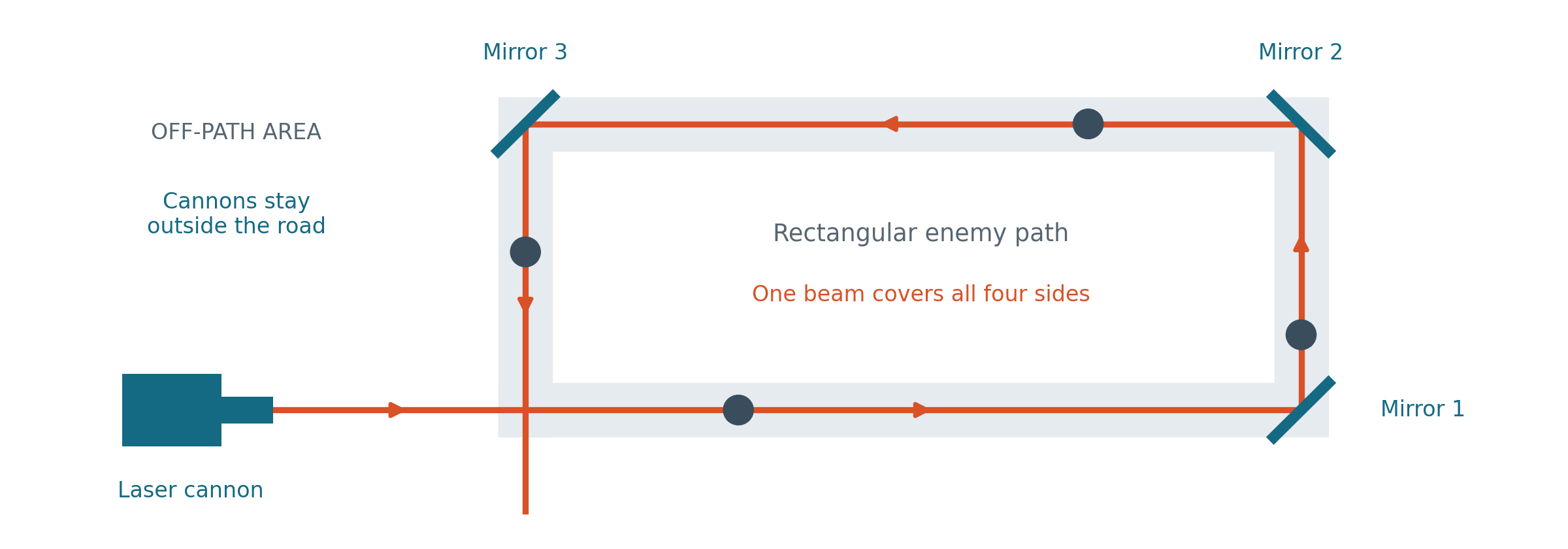
Refraction Defense. This is a top-down, real-time laser tower defense game where players place and rotate mirrors to maximize the coverage of a limited number of laser cannons across enemy paths.
2 Project Experience
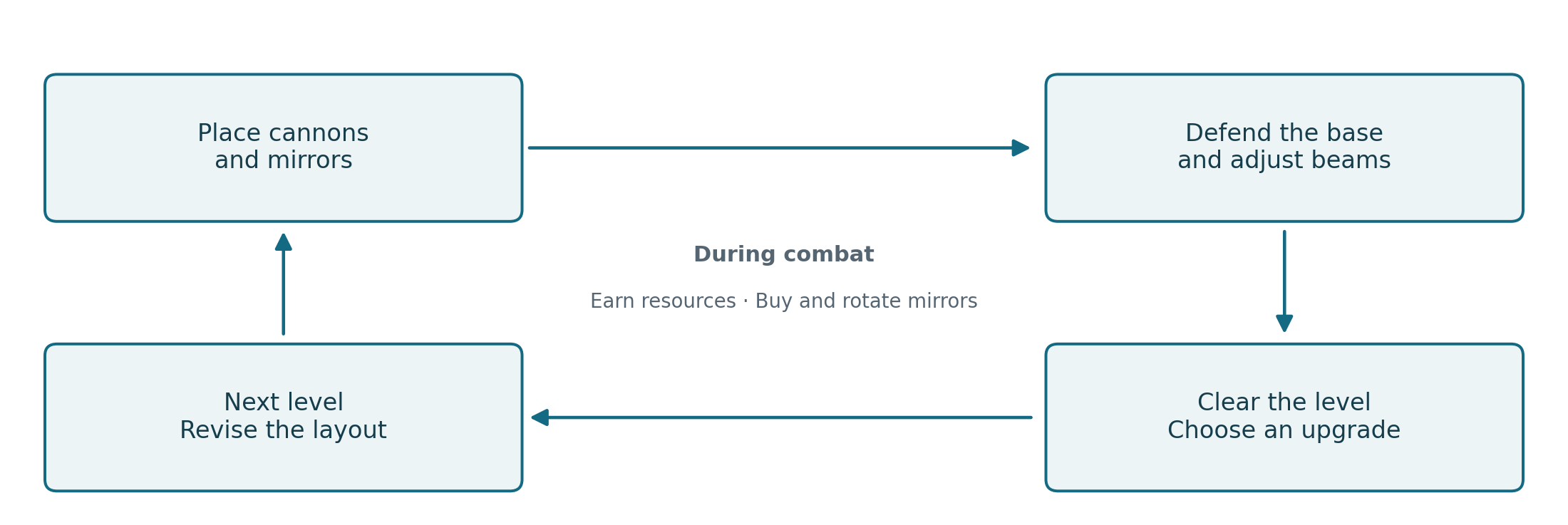
In each level, players can place several laser cannons outside the enemy paths as enemies advance toward the base along fixed paths. After accumulating resources, players purchase mirrors and position them where laser beams pass, using reflections to make a single cannon’s beam bounce across multiple path sections. During enemy attacks, players can still freely place and rotate mirrors to redirect fire toward vulnerable areas. As levels progress, new types of mirrors, such as scattering mirrors, refractive mirrors, rotating mirrors, and prisms that split a single beam into red, green, and blue beams, are gradually unlocked (the colors correspond to resistance mechanics planned for later development). After clearing a level, players can choose roguelike-style upgrades, such as enabling mirrors to reflect and refract light simultaneously, then reconfigure their layouts around these new effects.
3 Game Objective
The player’s goal is to prevent enemies from reaching the base and progress as far as possible through the levels. Enemies that break through the defenses reduce the base’s health; once its health reaches zero, the run ends. With limited resources, players must decide which components to purchase and how to use existing beam paths to defend multiple routes. For now, resources are planned to come from defeating enemies, with specific rewards and prices to be adjusted during playtesting.
4 Player Actions
Players use the mouse to select laser cannons or mirrors, place them in allowed positions, and adjust the mirrors’ angles. Laser cannons must be placed off the enemy paths; mirrors can be placed on the paths to redirect beams. When a component is selected, the screen displays the corresponding beam path, helping players determine which routes will be affected by adjustments. The battle continues as players observe enemy positions, purchase new mirrors, or rotate existing ones to redirect fire toward areas that need it more urgently. After clearing a level, players choose one of the available upgrades and continue experimenting with different combinations.
5 Project Concept and Interaction
I want to explore how limited resources can be given new purposes through different arrangements. The same laser cannon, paired with different types of mirrors placed at different locations and angles, can create different defensive strategies. Players grow not only by acquiring more components but also by gradually understanding the relationships between them. Future updates may introduce new challenges, such as completing levels using the fewest possible mirrors.
Real-time adjustments create trade-offs in these relationships: rotating a mirror might save a path on the verge of being overrun, yet leave a previously secure section unprotected. Regular mirrors change a beam’s direction, beam-splitting components expand coverage, and rotating mirrors sweep fire across different positions over time. Level upgrades further change the possible component combinations.
6 Intended Feelings
I want players to feel satisfied when they first connect a beam path and realize a single cannon can cover multiple sections; to feel joy when their strategy succeeds; to experience tension and excitement as they quickly rotate mirrors to save the base when enemies are about to reach it; and to be eager to try combinations they had not considered before after acquiring new mirrors or upgrades. After failing, players should be able to identify which part of the beam path or which adjustment went wrong and want to try again.
7 Target Audience
I’m targeting students who enjoy strategic planning, like watching others play, and are eager to give advice to their friends, especially in class or at campus gaming events. The game is played by one person, while others can clearly see the layout on screen, including paths, enemies, and lasers, allowing them to point out where enemies are getting through or discuss how to rotate mirrors.
Early levels will introduce only laser cannons and basic mirrors, gradually adding new components to make the game easier for newcomers to learn. The visuals prioritize beam paths, mirror orientations, and base health, so spectators can understand the impact of each action. After each run, players can quickly restart the game, making it easy for classmates to take turns trying out their own layouts.
8 Programming Plan and Timeline
I plan to develop the game using Unity 2D and C#. I’ve already learned input handling, object instantiation, collision detection, timers, lists, and GameManager, which can be used to implement purchases, enemy waves, the economy, and base health. Next, I need to learn laser path detection and rendering, reflection direction calculations, successive reflections and beam splitting, as well as mouse-based selection, placement, and rotation of components. The first test will focus on whether the beam path and damage along it update correctly after a mirror is rotated.
The prototype will initially include a map with two paths, one type of laser cannon, and standard mirrors, enabling enemies to advance, take damage, and reduce base health, while also implementing the economy, purchases, real-time adjustments, and restarting. Later, I’ll add a beam-splitting component and a set of upgrades offered after clearing levels. Additional mirror types will be added later, with priority given to ensuring the core gameplay is complete and playable.
From now until final submission, I plan to work through the following stages, aligning specific dates with the course’s prototype and final submission deadlines.
Initial phase, about one-third of the total time: Implement enemy movement, laser hits, mirror reflections, and real-time rotation, testing the most challenging part, the beam path system, first.
Before prototype submission: Connect purchases, the economy, base health, and level progression to complete a playable graybox prototype. Focus playtesting on whether players understand reflections and how easily they can adjust mirrors.
After prototype feedback: Improve controls and difficulty, and add beam splitting and upgrades after clearing levels; add other mirrors, visuals, and sound effects as progress allows.
Final phase, about one-fifth of the total time: Stop adding major features, check the limits on successive reflections and split beams, fix bugs, test the Windows build, and prepare screenshots, control instructions, and the itch.io page.