More coverage, through arrangement.
Players place laser cannons outside enemy paths, then buy and position mirrors to redirect their beams. With the right arrangement, a single cannon can cover several sections of a route.
I want to explore how limited resources can be given new purposes through different arrangements. Progress comes from acquiring components and learning how their positions, angles, and effects work together.
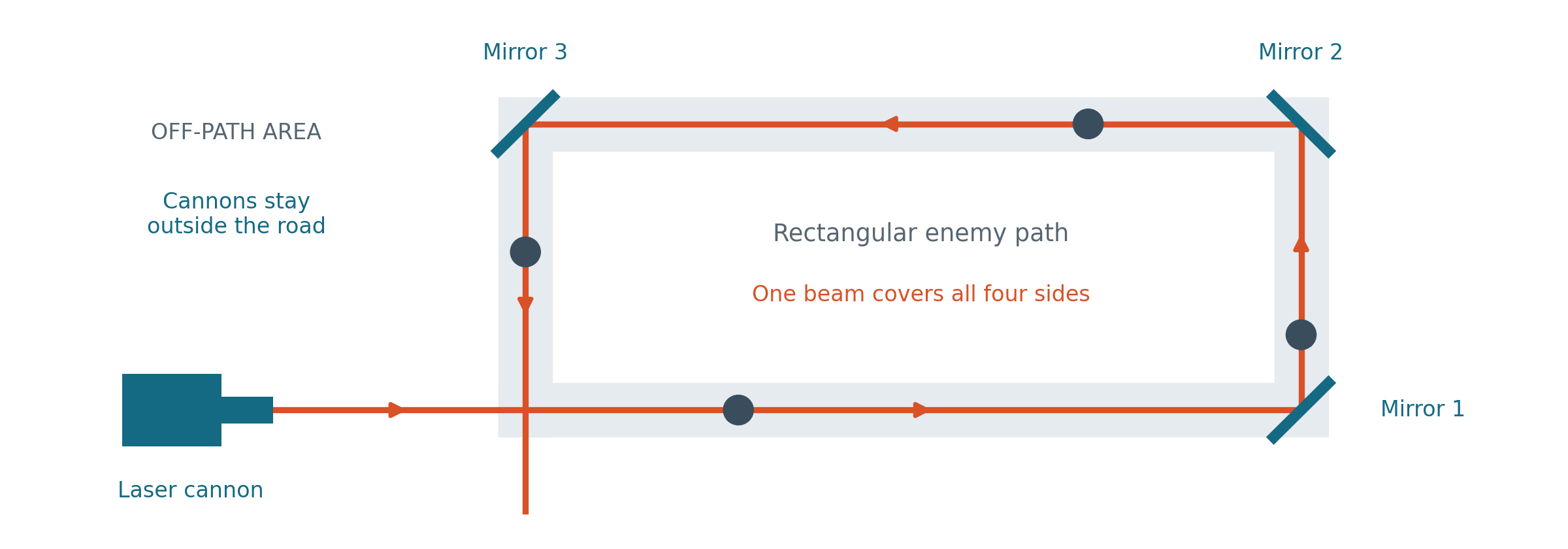
Every adjustment changes the defense.
The battle continues while players select, place, and rotate components with the mouse. Selecting a component reveals its beam path, so players can see which sections of the route an adjustment would affect.
Rotating a mirror might save a path on the verge of being overrun, yet leave a previously secure section unprotected.
Spend or rearrange
Resources are planned to come from defeating enemies. Players decide whether to purchase a component or get more coverage from the pieces already in place. Rewards and prices will need playtesting.
Protect or redirect
Enemies follow fixed paths toward the base. When a section becomes vulnerable, players can rotate a mirror to move firepower there, changing coverage elsewhere.
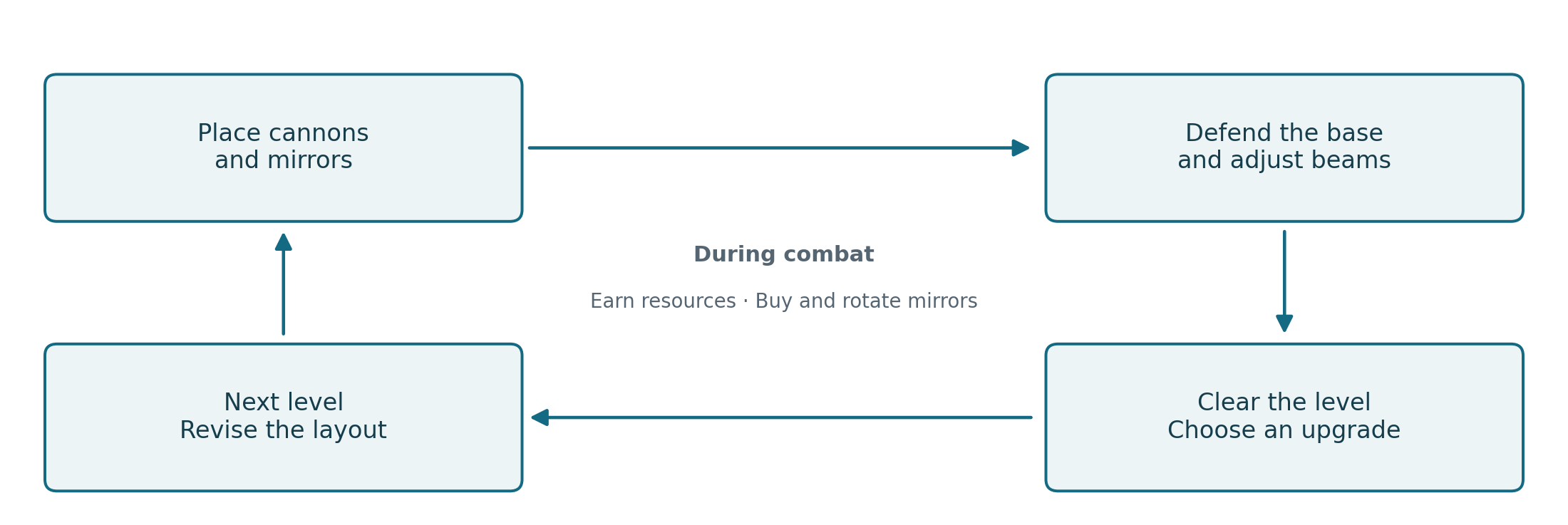
A strategy others can see.
I want the first connected beam path to bring a small moment of discovery: one cannon can protect more than expected. During a wave, that satisfaction gives way to the tension of making adjustments before enemies reach the base.
The intended audience is students who enjoy strategic planning and watching friends play. Clearly visible paths, enemies, mirrors, and lasers should make it possible for spectators to follow decisions and suggest their own solutions.
After a failed run, players should be able to identify which part of the layout or which adjustment went wrong, then quickly restart and try again.
Test the reflection system first.
The first technical test will check whether the beam path and damage update correctly when a mirror rotates. This is the main implementation risk identified in the proposal.
First playable prototype
A map with two paths, one laser cannon type, and standard mirrors. Enemy movement, damage, base health, purchases, real-time adjustments, and restarting form the initial scope.
Later additions
A beam-splitting component and upgrades between levels. Scattering, refractive, and rotating mirrors may follow. RGB prisms and color-based resistances remain future ideas.
Early playtests will focus on whether players understand reflections and how easily they can select and rotate mirrors.
From proposal to playable game.
The stages below are planned work. Dates will follow the course’s prototype and final submission deadlines.
Prove the core system
Implement enemy movement, laser hits, mirror reflections, and real-time rotation. Use roughly the first third of development time to test the beam path system.
Build the graybox
Connect purchases, the economy, base health, and level progression before prototype submission. Test reflection readability and control usability.
Iterate after feedback
Improve controls and difficulty. Add beam splitting and upgrades after clearing levels, with additional mirrors, visuals, and sound as time allows.
Prepare the final build
Reserve roughly the final fifth of development time for bug fixes, reflection and beam-splitting limits, Windows testing, screenshots, controls, and an itch.io page.
Read the complete proposal.
The full document includes the planned interactions, intended audience, programming tasks, and development priorities.